Nov 2023 - Apr 2025
MyGarage -
Designing the foundation of a B2B customer portal at Daimler Truck North America
From concept to MVP pilot — leading design as the sole UX on a project that reframed how DTNA reaches its customers.

DTNA's customer base is 75%+ small-to-medium businesses, historically served through dealer-mediated channels designed around the largest accounts.
14 logins, 73 apps, information scattered, no direct-to-customer touchpoint. MyGarage was scoped as the first attempt to change that.
14
different logins
73
customer-facing apps

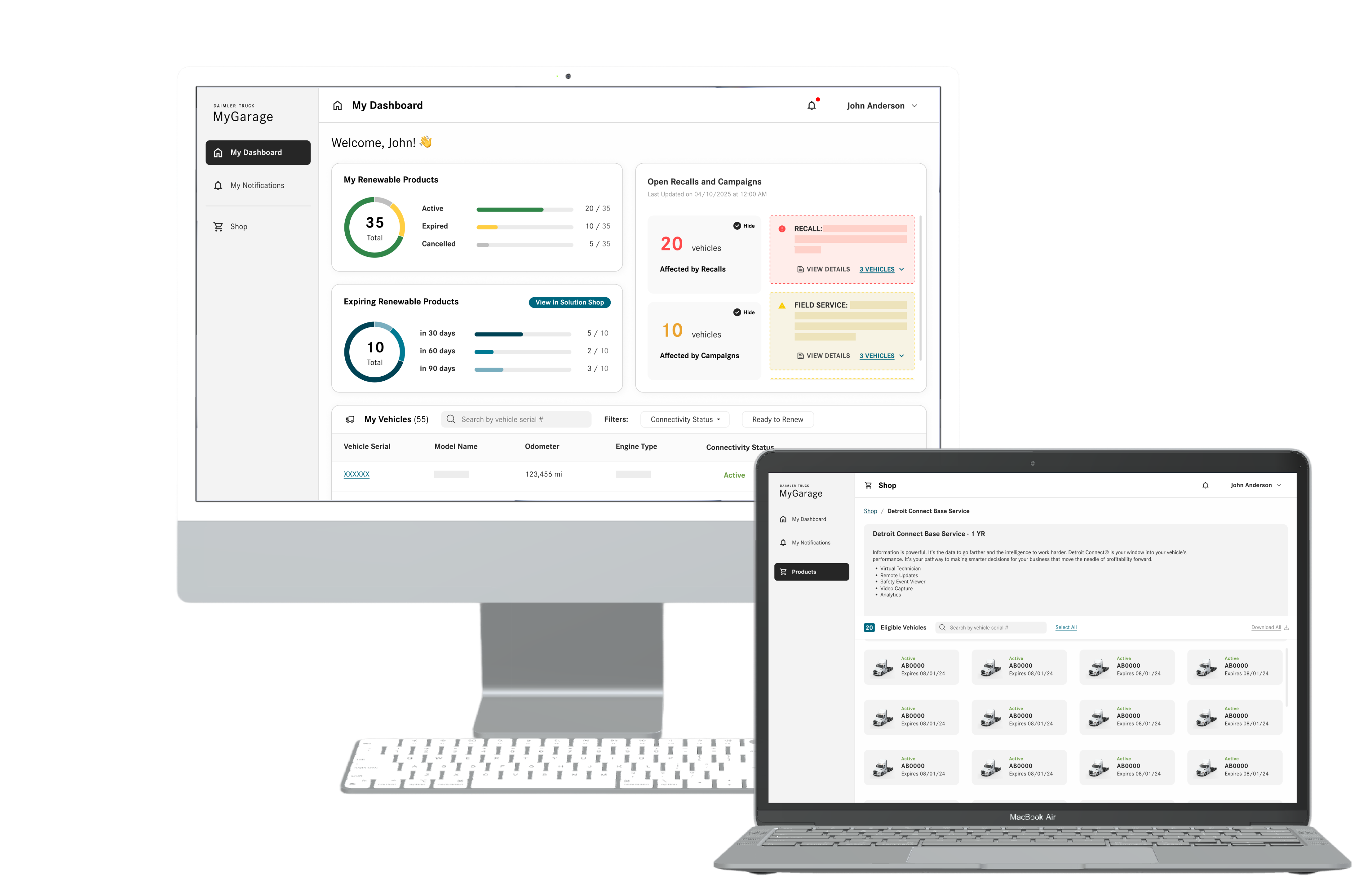
Abstracted for NDA reasons.
Role
Sole UI/UX Designer
Junior UI/UX → effectively project lead
Joined as Junior UI/UX Designer. Sole designer on the project for 18 months. Led research, design, and stakeholder presentation directly with PM, PO, Lead Architect. Working scope and pace was well above standard junior level — name that factually, let it stand.
Contraints
Partners closely with Product Manager, Product Owner, and Lead Architect on day-to-day decisions, and aligning a broad set of internal stakeholders on the longer-term direction.
Timeline
Nov 2023 - Apr 2025
Company
Daimler Truck North America
Status
Pilot launched Dec 2024 with 12 beta customers.
Initial scope & what we set out to build
The first version of MyGarage was scoped as a self-service portal across the full fleet lifecycle. Fleet managers would be able to view their organization details, vehicle warranties, and connectivity subscriptions in one place — and from that same place, take action on things that historically required a phone call: configuring and starting new truck purchases, scheduling service, transferring vehicles to second owners, managing connectivity service subscriptions, and surfacing actionable items across the fleet's day-to-day operations.
The ambition was to compress workflows that often spanned days into something fleet managers could handle in minutes. It was also, quietly, a structural shift — most of these actions traditionally routed through a dealer or a CS rep, and putting them in the customer's hands was the first time DTNA had seriously attempted that kind of direct-to-customer relationship at scale.
The scope wasn't just ambitious as a product; it was ambitious as a channel, and a meaningful share of the design problem turned out to be navigating what that meant for everyone — customers, dealers, and the internal teams whose products MyGarage was bringing together.
Decision: scoping the MVP
Most of the action layer didn't ship in V1.
The reason wasn't design — it was infrastructure. Several of the workflows we wanted to enable required data pipelines and transactional systems DTNA didn't yet have built. Customer-initiated purchases, transfers, scheduling — the company genuinely didn't have a way to support some of these end-to-end at the time. Building those systems sat outside the project's scope and timeline.
Other parts of the original scope ran into different constraints. Bringing 73 customer-facing apps into a single portal required earning buy-in from teams that owned those products independently, and not every team wanted to be part of MyGarage. Budget limited how broadly we could invest in any one workflow. And because DTNA's customer relationships had always flowed through its dealer network, every direct-to-customer capability had to be designed in a way that complemented — rather than disrupted — that channel. For existing customers, who were used to the dealer-mediated model, the rollout also had to feel like an addition, not a replacement.
By the time these constraints lined up, the original concept had to come down significantly.
The question became: what was still worth shipping?
Looking back at early customer research, one theme had been consistent. Customers weren't only frustrated that they couldn't do things directly — they were frustrated that they couldn't see things. Information about their own fleets, warranties, subscriptions, and entitlements was scattered across 14 logins and 73 apps, or locked behind a dealer call. Solving the visibility problem alone would meaningfully change how fleet managers operated day-to-day.
I argued for rescoping MyGarage around transparency. The portal would become a single source of truth for fleet data — surfacing what customers couldn't easily find before, organized around their fleets, with clear paths to the next step even when that next step still happened off-platform. Action capability was deferred to later phases as the underlying systems caught up.
What we shipped wasn't a smaller version of the original concept — it was a different product, designed around the constraint. The original ambition was still the long-term direction, but the V1 had to be a product that could stand on its own. As the pilot would soon show, it did.
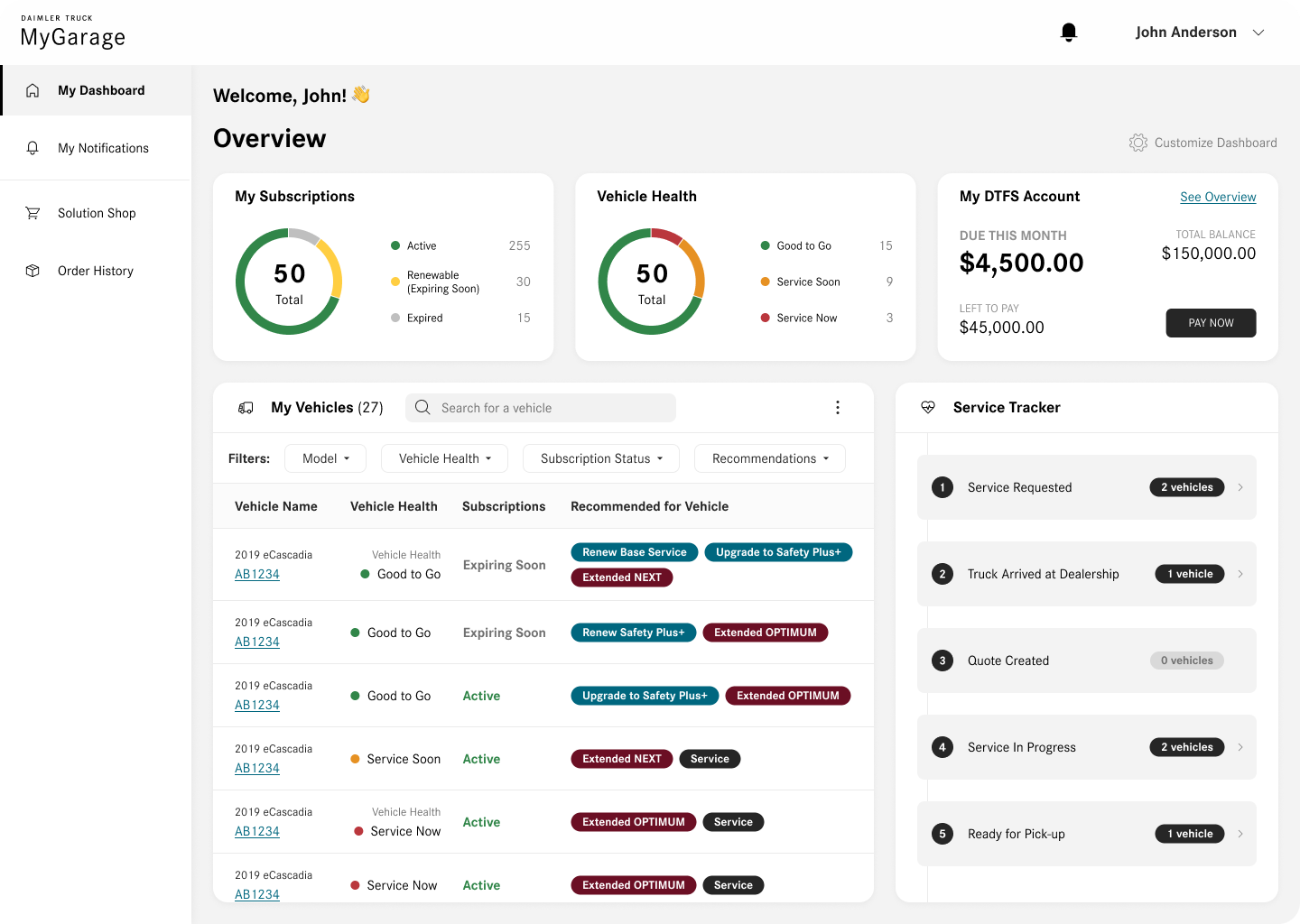
Initial scope
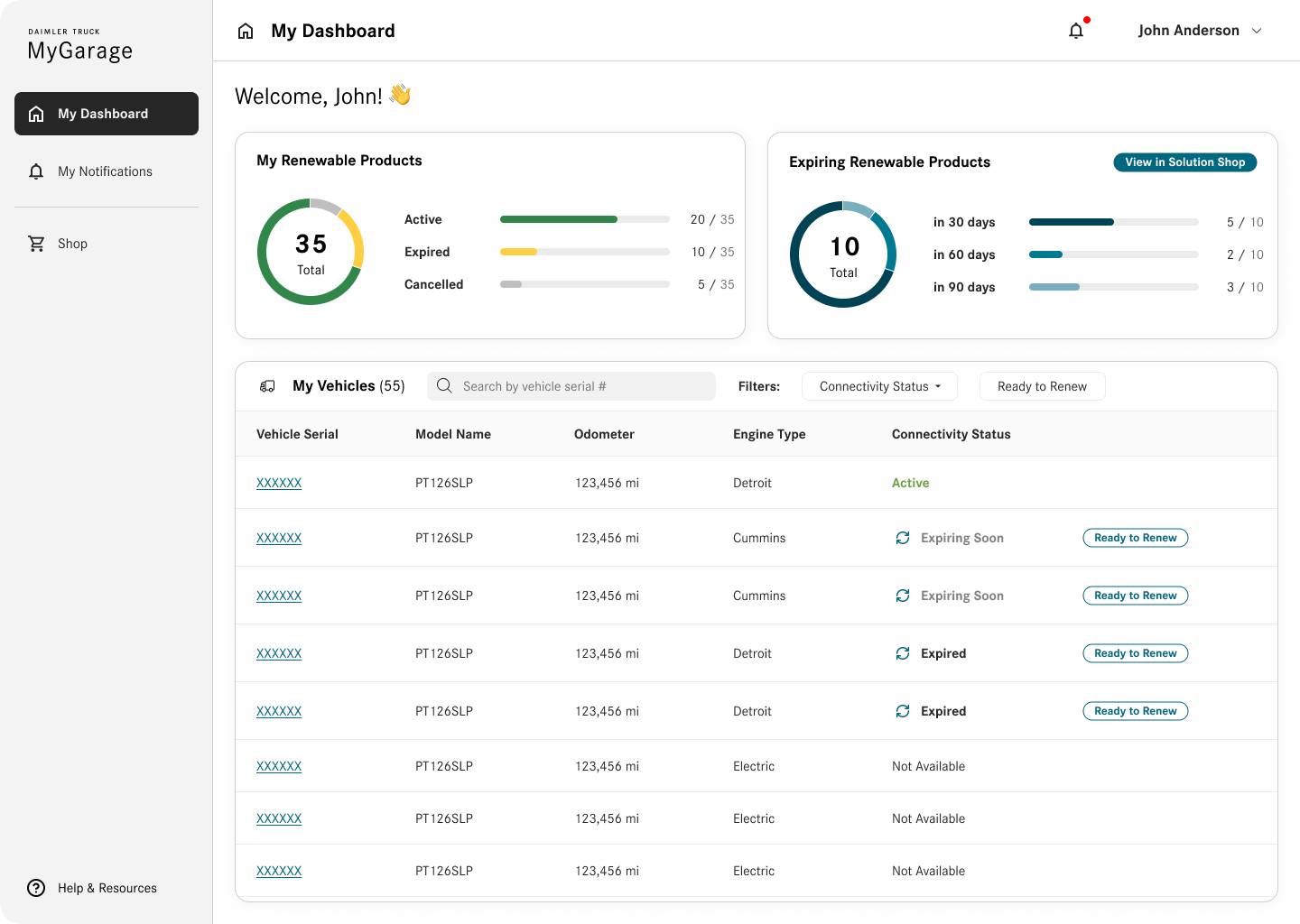
MVP Pilot
The Pilot Launch
We launched MyGarage to pilot in December 2024 with 12 beta customers — a mix of fleet managers and operators across the small-to-medium business segment the project had been scoped around.
The feedback validated the rescope.
What customers focused on, almost without exception, was the kind of information the portal surfaced. Specifically: urgent, action-driving data — anything that signaled they needed to take immediate action, especially when there was money on the line. Warranty status changes, subscription expirations, fault events, anything that translated to "this could cost us if we miss it." The transparency-first design wasn't a fallback for the action layer we'd cut. It was the thing they'd been missing most.
What I learned
Going into this project, I thought I was hired to design the best possible version of this new web portal, and then just defend it against whatever constraints came its way. After 18 months, I left with a different outlook on the work. The stakeholder alignment, dealer balance, missing infrastructure, internal caution about a new channel: they weren't obstacles in the way of the design, but rather the design problem itself. The most senior thing I did on this project wasn't a screen or a flow; it was deciding to rescope around transparency instead of fighting for the original action-heavy concept. That call is the lesson I take into every project now.
In April 2025, the project was restructured. MyGarage became Customer Portal, and I moved into a UX Lead role.
Nov 2023 - Apr 2025
MyGarage -
Designing the foundation of a B2B customer portal at Daimler Truck North America
From concept to MVP pilot — leading design as the sole UX on a project that reframed how DTNA reaches its customers.
DTNA's customer base is 75%+ small-to-medium businesses, historically served through dealer-mediated channels designed around the largest accounts.
14 logins, 73 apps, information scattered, no direct-to-customer touchpoint. MyGarage was scoped as the first attempt to change that.
14
different logins
73
customer-facing apps
Abstracted for NDA reasons.
Role
Sole UI/UX Designer
Junior UI/UX → effectively project lead
Joined as Junior UI/UX Designer. Sole designer on the project for 18 months. Led research, design, and stakeholder presentation directly with PM, PO, Lead Architect. Working scope and pace was well above standard junior level — name that factually, let it stand.
Contraints
Partners closely with Product Manager, Product Owner, and Lead Architect on day-to-day decisions, and aligning a broad set of internal stakeholders on the longer-term direction.
Timeline
Nov 2023 - Apr 2025
Company
Daimler Truck North America
Status
Pilot launched Dec 2024 with 12 beta customers.
Initial scope & what we set out to build
The first version of MyGarage was scoped as a self-service portal across the full fleet lifecycle. Fleet managers would be able to view their organization details, vehicle warranties, and connectivity subscriptions in one place — and from that same place, take action on things that historically required a phone call: configuring and starting new truck purchases, scheduling service, transferring vehicles to second owners, managing connectivity service subscriptions, and surfacing actionable items across the fleet's day-to-day operations.
The ambition was to compress workflows that often spanned days into something fleet managers could handle in minutes. It was also, quietly, a structural shift — most of these actions traditionally routed through a dealer or a CS rep, and putting them in the customer's hands was the first time DTNA had seriously attempted that kind of direct-to-customer relationship at scale.
The scope wasn't just ambitious as a product; it was ambitious as a channel, and a meaningful share of the design problem turned out to be navigating what that meant for everyone — customers, dealers, and the internal teams whose products MyGarage was bringing together.
Decision: scoping the MVP
Most of the action layer didn't ship in V1.
The reason wasn't design — it was infrastructure. Several of the workflows we wanted to enable required data pipelines and transactional systems DTNA didn't yet have built. Customer-initiated purchases, transfers, scheduling — the company genuinely didn't have a way to support some of these end-to-end at the time. Building those systems sat outside the project's scope and timeline.
Other parts of the original scope ran into different constraints. Bringing 73 customer-facing apps into a single portal required earning buy-in from teams that owned those products independently, and not every team wanted to be part of MyGarage. Budget limited how broadly we could invest in any one workflow. And because DTNA's customer relationships had always flowed through its dealer network, every direct-to-customer capability had to be designed in a way that complemented — rather than disrupted — that channel. For existing customers, who were used to the dealer-mediated model, the rollout also had to feel like an addition, not a replacement.
By the time these constraints lined up, the original concept had to come down significantly.
The question became: what was still worth shipping?
Looking back at early customer research, one theme had been consistent. Customers weren't only frustrated that they couldn't do things directly — they were frustrated that they couldn't see things. Information about their own fleets, warranties, subscriptions, and entitlements was scattered across 14 logins and 73 apps, or locked behind a dealer call. Solving the visibility problem alone would meaningfully change how fleet managers operated day-to-day.
I argued for rescoping MyGarage around transparency. The portal would become a single source of truth for fleet data — surfacing what customers couldn't easily find before, organized around their fleets, with clear paths to the next step even when that next step still happened off-platform. Action capability was deferred to later phases as the underlying systems caught up.
What we shipped wasn't a smaller version of the original concept — it was a different product, designed around the constraint. The original ambition was still the long-term direction, but the V1 had to be a product that could stand on its own. As the pilot would soon show, it did.
Initial scope
MVP Pilot
The Pilot Launch
We launched MyGarage to pilot in December 2024 with 12 beta customers — a mix of fleet managers and operators across the small-to-medium business segment the project had been scoped around.
The feedback validated the rescope.
What customers focused on, almost without exception, was the kind of information the portal surfaced. Specifically: urgent, action-driving data — anything that signaled they needed to take immediate action, especially when there was money on the line. Warranty status changes, subscription expirations, fault events, anything that translated to "this could cost us if we miss it." The transparency-first design wasn't a fallback for the action layer we'd cut. It was the thing they'd been missing most.
What I learned
Going into this project, I thought I was hired to design the best possible version of this new web portal, and then just defend it against whatever constraints came its way. After 18 months, I left with a different outlook on the work. The stakeholder alignment, dealer balance, missing infrastructure, internal caution about a new channel: they weren't obstacles in the way of the design, but rather the design problem itself. The most senior thing I did on this project wasn't a screen or a flow; it was deciding to rescope around transparency instead of fighting for the original action-heavy concept. That call is the lesson I take into every project now.
In April 2025, the project was restructured. MyGarage became Customer Portal, and I moved into a UX Lead role.
Nov 2023 - Apr 2025
MyGarage -
Designing the foundation of a B2B customer portal at Daimler Truck North America
From concept to MVP pilot — leading design as the sole UX on a project that reframed how DTNA reaches its customers.
DTNA's customer base is 75%+ small-to-medium businesses, historically served through dealer-mediated channels designed around the largest accounts.
14 logins, 73 apps, information scattered, no direct-to-customer touchpoint. MyGarage was scoped as the first attempt to change that.
14
different logins
73
customer-facing apps
Abstracted for NDA reasons.
Role
Sole UI/UX Designer
Junior UI/UX → effectively project lead
Joined as Junior UI/UX Designer. Sole designer on the project for 18 months. Led research, design, and stakeholder presentation directly with PM, PO, Lead Architect. Working scope and pace was well above standard junior level — name that factually, let it stand.
Contraints
- Limited precedent for direct-to-customer at DTNA
- Dealer relationships to balance carefully
- Cross-business-unit stakeholder alignment required
- Internal systems not yet built for many of the actions we wanted to enable
Timeline
Nov 2023 - Apr 2025
Company
Daimler Truck North America
Status
Pilot launched Dec 2024 with 12 beta customers.
Initial scope & what we set out to build
The first version of MyGarage was scoped as a self-service portal across the full fleet lifecycle. Fleet managers would be able to view their organization details, vehicle warranties, and connectivity subscriptions in one place — and from that same place, take action on things that historically required a phone call: configuring and starting new truck purchases, scheduling service, transferring vehicles to second owners, managing connectivity service subscriptions, and surfacing actionable items across the fleet's day-to-day operations.
The ambition was to compress workflows that often spanned days into something fleet managers could handle in minutes. It was also, quietly, a structural shift — most of these actions traditionally routed through a dealer or a CS rep, and putting them in the customer's hands was the first time DTNA had seriously attempted that kind of direct-to-customer relationship at scale.
The scope wasn't just ambitious as a product; it was ambitious as a channel, and a meaningful share of the design problem turned out to be navigating what that meant for everyone — customers, dealers, and the internal teams whose products MyGarage was bringing together.
Decision: scoping the MVP
Most of the action layer didn't ship in V1.
The reason wasn't design — it was infrastructure. Several of the workflows we wanted to enable required data pipelines and transactional systems DTNA didn't yet have built. Customer-initiated purchases, transfers, scheduling — the company genuinely didn't have a way to support some of these end-to-end at the moment. Building those systems sat outside the project's scope and timeline, and beyond our team’s responsibilities.
Other parts of the original scope ran into different constraints. Bringing 73 customer-facing apps into a single portal meant working across the boundaries of the teams that owned those products independently — each with its own roadmap and its own stake in how its product showed up to customers. And because DTNA's customer relationships had always flowed through its dealer network, every direct-to-customer capability had to be designed in a way that complemented — rather than disrupted — that channel.
The question became: what was still worth shipping?
Looking back at early customer research, one theme had been consistent. Customers weren't only frustrated that they couldn't do things directly — they were frustrated that they couldn't see things. Information about their own fleets, warranties, subscriptions, and entitlements was scattered across 14 logins and 73 apps, or locked behind a dealer call. Solving the visibility problem alone would meaningfully change how fleet managers operated day-to-day.
My team and I argued for rescoping MyGarage around transparency. The portal would become a single source of truth for fleet data — surfacing what customers couldn't easily find before, organized around their fleets, with clear paths to the next step even when that next step still happened off-platform. Action capability was deferred to later phases as the underlying systems caught up.
What we shipped wasn't a smaller version of the original concept — it was a different product, designed around the constraint. The original ambition was still the long-term direction; the V1 had to stand on its own. As the pilot would soon show, it did.
Initial scope

MVP Pilot
The Pilot Launch
We launched MyGarage to pilot in December 2024 with 12 beta customers — a mix of fleet managers and operators across the small-to-medium business segment the project had been scoped around.
The feedback validated the rescope.
What customers focused on, almost without exception, was the kind of information the portal surfaced. Specifically: urgent, action-driving data — anything that signaled they needed to take immediate action, especially when there was money on the line. Warranty status changes, subscription expirations, fault events, anything that translated to "this could cost us if we miss it." The transparency-first design wasn't a fallback for the action layer we'd cut. It was the thing they'd been missing most.
What I learned
Going into this project, I thought I was hired to design the best possible version of this new web portal, and then just defend it against whatever constraints came its way. After 18 months, I left with a different outlook on the work. The stakeholder alignment, dealer balance, missing infrastructure, internal caution about a new channel: they weren't obstacles in the way of the design, but rather the design problem itself. The most senior thing I did on this project wasn't a screen or a flow; it was deciding to rescope around transparency instead of fighting for the original action-heavy concept. That call is the lesson I take into every project now.
In April 2025, the project was restructured. MyGarage became Customer Portal, and I moved into a UX Lead role. → Read Part 2: Customer Portal